First created in 1972, the Honda Civic was powered by a 1169cc, FWD engine. Early models of the Civic were typically outfitted with a basic AM radio, a rudimentary heater, foam-cushioned plastic trim, two-speed wipers and painted steel rims with a chromed wheel nut cap.

First generation Civic 1972-1979
The 1980 Civic debuted with a more angular shape, increased engine power, and larger dimensions in all models. The wheelbase now measured 88.6 inches (225 cm) for the hatchback (the two-door "sedan" was dropped) and 91.3 inches (232 cm) for the wagon. All Civic engines now used the CVCC design; the base 1335 cc ("1300") engine made 55 hp (41 kW), while the 1488 cc ("1500") engine produced 67 hp (50 kW). Three transmissions were offered: a four-speed manual (on base models), a five-speed manual and a two-speed automatic.

Second generation. 1980-1983
For the third generation, the vehicle wheelbase was increased by 2–5 inches (13 cm) to 93.7 inches (hatchback) or 96.5 inches (sedan). A 3-door hatchback, 4-door sedan, 4-door "Shuttle" wagon, and CRX coupe shared common underpinnings. This included independent front control arms with torsion bar springs and a semi-independent rear beam with coil springs. However, the body panels were completely different for each body style, with nothing interchangeable beyond the front bumper and headlights.
The sedan and hatchback shared the same dashboard, but the CRX and wagons both had their own unique dash (CRX having a covered cubby in the middle of the dash, the wagon having a pop up set of vents which could be used or retracted into the dash). A new 12-valve (three valves per cylinder) 76 hp, 1500 cc engine was introduced. The base hatchback and CRX 1.3 used the 1300 cc 8-valve engine giving 60 hp (45 kW). The DX and 1500S model hatchbacks shared the new 1500 cc engine with the sedan, wagon and CRX 1.5. The 1500S model achieved over 50 mpg highway. The CRX was a Civic with a slightly different body; it was strictly a 2-seater in the US with a lockable storage compartment, while it was offered to the rest of the world with a rear seat. The CRX lineup added the Si model in 1985 which used Honda's PGM-FI fuel injection on the 1488cc 4 cylinder; in the US this generated 91 horsepower.

Third generation 1984-1987
For 1988, the car's wheelbase was increased to 98.4 inches (250 cm). The body was redesigned with a lower hood line and more glass, giving less drag. The model range was fairly limited for the US, whereas the European and Japanese markets had a wider range. A 1500 cc 16-valve fuel injected engine giving 92 hp (68 kW) was used in the DX hatchback and sedan, new LX sedan and the American market wagon. The Si and four-wheel drive wagons were powered by a 1.6 L 16-valve engine, rated at 108 hp (81 kW). The base hatchback had a 70 hp (52 kW) version of the same 8-valve engine. All engines sold in the US were fuel injected. Carbureted models were available elsewhere. All Civics had a double-wishbone suspension. In 1990, the EX trim was introduced. Four-wheel drive wagons had standard steel wheels (white steel wheels with matching center caps were optional), a 6-speed manual transmission (with a super-low gear left of first) or an optional 4-speed automatic. Four-wheel drive was also available on the sedan in some markets.

Fourth generation 1988-1991
The fifth generation of the Civic had a more wedge-shaped body and the length was increased to 257 cm (101.3 inches) for the two-door hatchback and 262 cm (103.2 inches) for the four-door sedan. The wagon was also dropped for overseas markets, while the previous generation wagon continued in Japan. This generation of Civic used lightweight materials to create a fuel efficient economy car. In addition, the SI hatchback and coupe, ESi/EX (1.6L SOHC VTEC 125PS) also provoked to the popularity of (relatively) high performance 1.6L segment.
All DX and LX models used the D15B7 a 16 valve non-VTEC engine rated at 102 bhp and near 100 Ft/lb. torque. DX and LX models were aimed towards the economy conscious market. Most of the CX models had the D15B8 which is an 8 valve non-VTEC engine rated at 79 bhp and the VX had the D15Z1 (VTEC-E engine) capable of 90bhp. The EX and EX-V had the D16Z6 SOHC VTEC engine. The SiR was equipped with the 1.6L B16A with VTEC. In Europe the DX had the D13B2, LSi had the D15B2 (hatchback) and D15B7 (Sedan) , VEi had the D15Z1, ESi had the D16Z6 and VTi had the B16A2. D15B7 engines were available in the 1994-95 civic coupe LSi.

Fifth generation 1992-1995
My favourite generation of the Civic would have to be the sixth generation. Trims available in the coupe body style were the DX, HX, EX and Si (only 1999 and 2000) (designated as the EJ6/7/8 and EM1, respectively). All CX, DX, Value Package, and LX models used the D16Y7. The HX had the D16Y5 and the EX had the D16Y8. The Si used the B16A2. In the UK, Europe, Australia and the Philippines, there were a number of sedans and aerodecks produced with the B18C4. Beginning in 1997[3], Honda produced the first iteration of Civic to receive the "Type-R" appellation (applied first to the Integra Type-R), with the EK9 chassis Civic Type-R. The Civic Type-R had a B16B engine with maximum output in the range of 189 PS JIS (185 hp/132 kW), increased over the more common 160 PS (158 hp/118 kW) B16A engine in the SiR/VTi models, and included various alterations to the chassis to improve handling and reduce weight (such as better welding of the frame, and removal of the radio and noise-suppressing materials). The type R also came in a few special paint colors, namely Championship White, Flamenco Black Pearl, and Phoenix Yellow. the Civic Type R came in hatchback form only and included a few special features that were never available in the U.S.A. such as power folding side mirrors, city lights, red recaro bucket seats, five lug wheel hubs,airbag and radio blockoff plates, red carpet and door panel trim, and power windows and door locks (although the coupe and sedan civics came with these stock on the EX and HX trims, they were never available on the hatchback).

Sixth generation 1996-2000
The Civic was redesigned in 2001, retaining exterior dimensions but increasing significantly in interior space. There was now a flat rear floor, giving better comfort to the rear seat passengers. A 115 hp engine now powered the Non-EX or Si Civic up 9 from the previous model's 106. Power in the EX remained at 127 but all non Si engines have been stroked to 1.7 liters.

Seventh generation 2001-2005
For 2006, Honda redesigned the Civic. In many countries (USA, UK, New Zealand), all models (including the base model) come standard with ABS and side and curtain airbags. Additionally, the 2006 models acquired ULEV-2 (Ultra Low Emission Vehicle) certification and boast a more powerful 1.8 litre engine than the 2005 counterparts while retaining almost equal fuel economy. In the North American market, the sedan, coupe, sedan Si (in Canada as the Acura CSX Type-S), coupe Si, and Hybrid models are available. An Si sedan began manufacture for the 2007 model year. The sedan and coupe are available in three trims (DX, LX, EX); however, the Civic Si and Hybrid are sold with relatively few options (such as a navigation system, automatic day/night compass mirrors, and wheel locks). The 2008 model brought some new features and a Si Sedan to Canada.
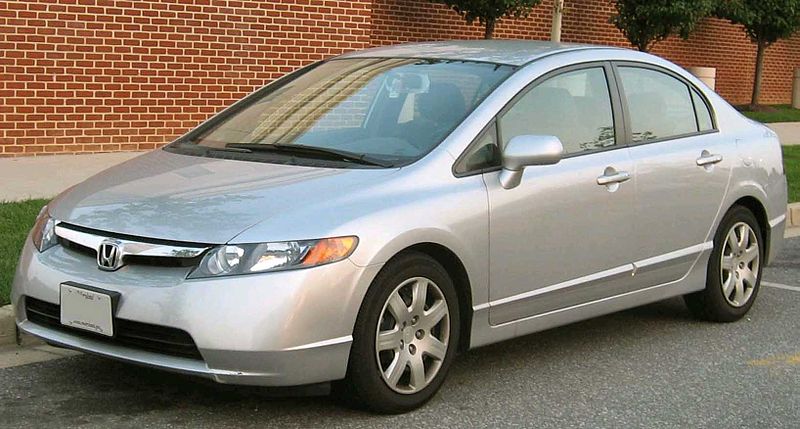
Eighth generation 2006-present


